
Social Sciences in Uncertain Times – 2026 Annual Emeritus Professor Andrew Jakubowicz Lecture

- This event has passed.
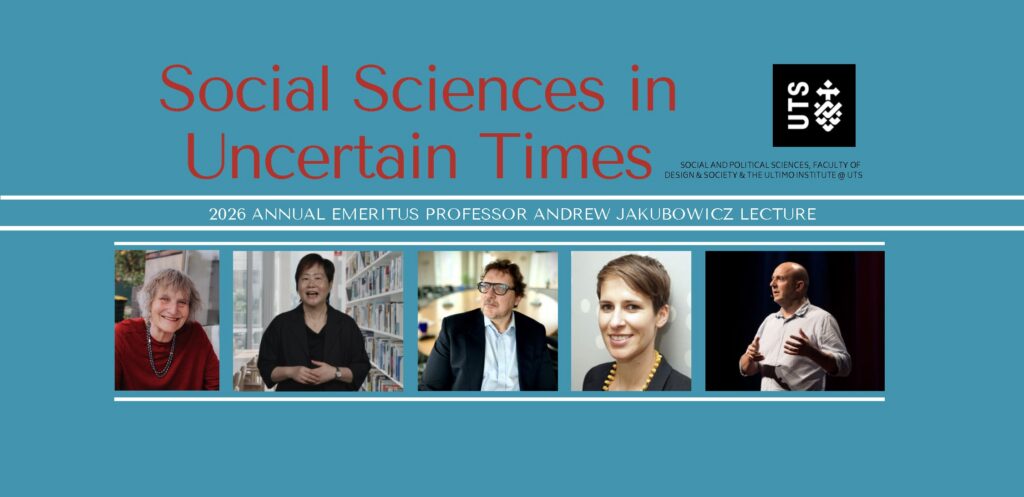
In an era marked by economic volatility, geopolitical tensions, climate disruption, rapid technological change, and declining public trust in expertise, the social sciences are more important than ever. Yet the disciplines themselves are also under pressure. Recent restructurings, funding pressures, and program reviews affecting humanities and social sciences across Australian universities raise fundamental questions about the future, value, and place of these fields in public life.
This year, the UTS Social and Political Sciences (SPS) Andrew Jakubowicz Annual Lecture, presented in collaboration with the UTS Ultimo Institute, invites us to reflect on the future of social sciences:
- Where are the pressures and attacks on the social sciences coming from?
- How can social scientists make meaningful contributions to public debate and policymaking?
- How can the social sciences help us understand and address the complex ‘wicked problems’ confronting contemporary societies?
Join our stellar panel of experts for a timely and thought-provoking discussion on the future of the social sciences – and why they matter now more than ever.
Speakers
Raewyn Connell is Professor Emerita at the University of Sydney and a Life Member of the National Tertiary Education Union in Australia. She has taught in several countries, and is a widely-cited researcher on gender relations, education, class structure, social justice, and the global economy of knowledge. Raewyn’s books include The Good University; Southern Theory; Masculinities; Gender & Power; Making the Difference; and Ruling Class Ruling Culture; and most recently, Trans Lives. She is the 2026 recipient of the international Kohli Prize for contributions to sociology. Raewyn has been involved in the labour movement, in work for gender equality, and in the unending struggle for peace.
Richard Denniss is the co-Chief Executive Officer at The Australia Institute. He is a prominent Australian economist, author and public policy commentator. He has published six books, including Econobabble, Curing Affluenza, Dead Right: How Neoliberalism Ate Itself and What Comes Next?, Big: The Role of the State in the Modern Economy, and Dead Centre: How political pragmatism is killing us and is a contributing author in What’s the Big Idea? and A Time for Bravery, released by Australia Institute Press.
Tamson Pietsch is Associate Professor in Social and Political Sciences and Director of the Australian Centre for Public History at UTS. Her research focuses on the history of ideas and the global politics of knowledge, with a particular focus on universities and other institutions of knowledge. Tamson is the author of The Floating University: Experience, Empire and the Politics of Knowledge (Chicago, 2023) and Empire of Scholars: universities networks and the British academic world, 1850-1939 (Manchester, 2013). She is currently researching the representation of historical events on Wikipedia, and writing about expertise in interwar Australia. Tamson received her DPhil from the University of Oxford, where she studied as a Rhodes Scholar. She has held academic posts at the Universities of Oxford and Sydney and Brunel University London.
Carl Rhodes is Professor of Business and Society at the University of Technology Sydney (UTS). An internationally recognised scholar, he researches and writes on business ethics, corporate power, leadership, democracy, inequality and the role of business in society. He is the author of acclaimed books including Stinking Rich: The Four Myths of the Good Billionaire (2025), Woke Capitalism (2022), Disturbing Business Ethics (2020) and CEO Society (2018). His work has been translated into multiple languages and has contributed to international debates on corporate responsibility, economic justice and business education. A frequent public commentator, his writing has appeared in outlets including The Guardian, The Conversation, Times Higher Education and The Australian Financial Review. He is widely recognised as a leading voice on the relationship between business, ethics and democracy.
Lai-Ha Chan is an International Relations scholar specialising in global governance and Indo-Pacific politics. She is a Senior Lecturer in the Social and Political Sciences Program at the University of Technology Sydney and a Research Associate at the Australia-China Relations Institute. She was a Fung Global Fellow at Princeton University (2016-17), a Japan Foundation Indo-Pacific Research Fellow (2025-26), and a Senior Visiting Fellow at Ritsumeikan University (2025-26), Japan. Her current research examines deep-sea mining governance and critical minerals, with a particular focus on China-US strategic competition and middle-power diplomacy in the Indo-Pacific. Her recent co-authored book, Who Governs Deep-Sea Mining? A Battle Between Global Governance and National Governance (Cambridge Elements in Earth System Governance, Cambridge University Press, 2026), examines the geopolitics of deep-sea mining beyond national jurisdiction.