
Discipline of Government and International Relations Collective Book Launch

- This event has passed.
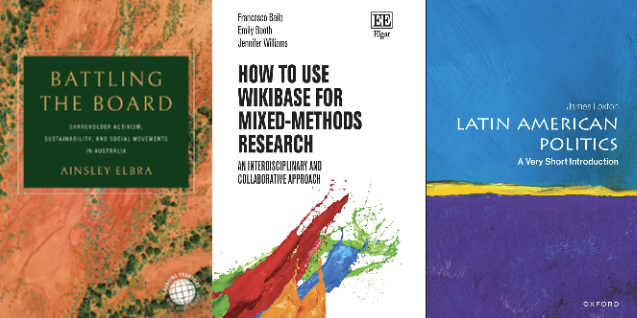
Please join us for a triptych book launch showcasing the latest works by academic staff from the Discipline of Government and International Relations (GIR), School of Social and Political Sciences, University of Sydney.
Battling the Board: Shareholder Activism, Sustainability, and Social Movements in Australia
Battling the Board examines the rise of ESG shareholder activism in Australia, where investors are increasingly pressuring companies to address issues such as climate change, Indigenous rights, modern slavery, and workers’ rights. Ainsley Elbra argues that this activism emerged to address gaps between societal expectations and corporate behaviour, despite Australia’s corporate governance system traditionally limiting investor influence. The book highlights how shareholder activism can drive corporate and industry change, while cautioning that government intervention can weaken the impact of successful social movements.
How to use Wikibase for Mixed-Methods Research: An Interdisciplinary and Collaborative Approach
by Francesco Bailo, Emily Booth, Jennifer Williams.
How to Use Wikibase for Mixed-Methods Research provides a practical guide to using the open-source Wikibase platform to support collaboration across diverse research methods and disciplines. Using case studies on online misinformation and political communication, the authors explain everything from setup to advanced workflows for managing and linking complex, multimodal data. The book also addresses the challenges of interdisciplinary research by offering strategies for developing shared terminology, ontologies, and workflows that accommodate different methodological approaches.
Latin American Politics: A Very Short Introduction
by James Loxton
This book provides a concise overview of major themes in Latin American politics, including populism, revolution, dictatorship, democracy, and ideological movements across the region’s 19 Spanish- and Portuguese-speaking countries. Using key historical and contemporary examples, it explores the challenges of governing amid poverty, inequality, and violence. It also highlights the fragility of democracy and warns of the risks posed by elected leaders who claim to represent “the people” while undermining democratic institutions.